 |
|||
Home page | Catalogue | Classes | Tables | Glossary | Notations | Links | Bibliography | Thanks | Downloads | Related Curves |
|||
 |
 |
||
too complicated to be written here. Click on the link to download a text file. |
|||
 |
|||
 |
|||
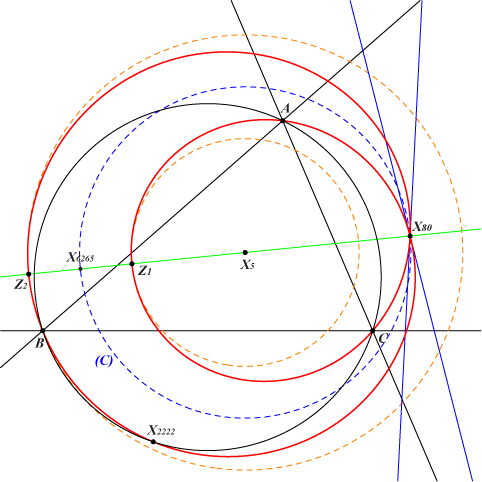
X(80), X(2222), X(56690), X(72774), X(72775), X(72776), X(72777), X(72778), X(72779), X(72780), X(72781), X(72782), X(72783), X(72784), X(72785), X(72786), X(72787), X(72788), X(72789), X(72790), X(72791), X(72792), X(72793), X(72794), X(72795), X(72796), X(72797), X(72798), X(72799), X(72800) reflections A1, B1, C1 of A, B, C in the line (L) passing through X(1), X(5), X(80), etc |
|||
 |
|||
 |
|
|
|
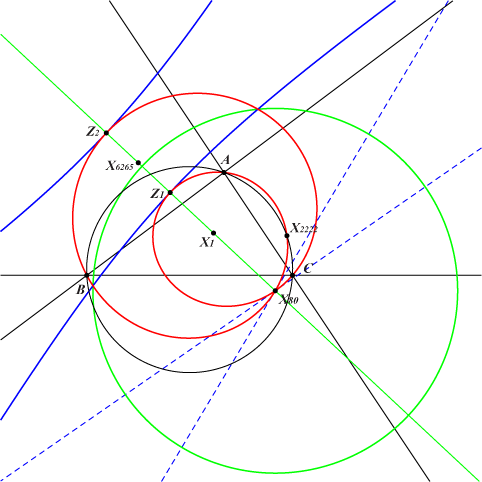
(contributed by Peter Moses, 2026-08-04) Q199 is the locus of the vertices of triangles sharing the same incircle and nine-point circle as ABC. Q199 is bicircular with singular focus X(5). It is symmetric in the line (L). Q199 has a double point at X(80). A line passing through X(80) meets Q199 again at two points whose midpoint lies on the circle (C) with center X(5) passing through X(80). In particular, the line (L) meets Q199 at Z1, Z2 with midpoint X(6265), the reflection of X(80) in X(5). Z1 is X(72799) and Z2 is X(72800) in ETC. The tangents to Q199 at A, B, C are the sidelines of the anticevian triangle of X(37). This triangle is perspective to the cevian triangle of every point M, the perspector being obviously the M-Ceva conjugate of X(37). The inverse of Q199 in a circle centered on X(80) is a hyperbola. The directions (ArcTan[Sqrt[(2*r + 3*R)/(R - 2*r)]]) of the hyperbola's asymptotes are parallel to the two tangents of Q199 at the double point X(80). The hyperbola is generally not nice. However, if the inverting circle centered on X(80) has radius Sqrt[2*r*(2*r + 3*R)], then the hyperbola is centered on X(6265) and passes through Z1 and Z2. See figure below. The osculating centers at X(80) are (a + b - c)*(a - b + c)*((b + c)^2*(9*a*b*c + (a + b + c)^3 - 4*(a + b + c)*(a*b + a*c + b*c)) +/- (a - b - c)*(2*a - b - c)*(b - c)*(a + b + c)*Sqrt[(R - 2*r)*(2*r + 3*R)]) : : , on line {12, 900}. The common squared radius of the two osculating circles is 4*r^2*R*(2*r + 3*R) / (2*r + R)^2. They pass through X(41689), the reflection of X(80) in X(12). |
|
|
|
 |
||
|
|
|
|
|
|
|
One neat example |
|
|
|
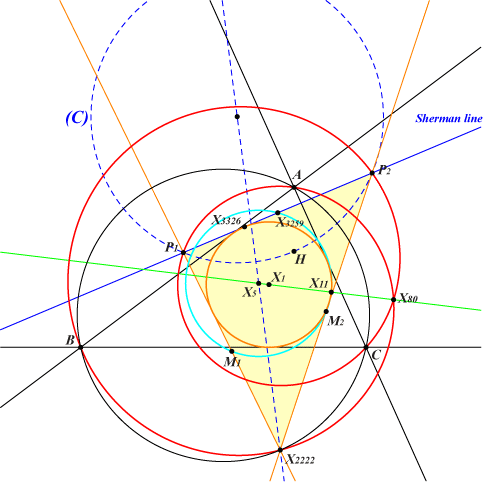 |
When X(2222) is a vertex of one of these triangles, let us denote by P1, P2 the others which lie : • on the circle (C), the homothetic of the nine-point circle under h(X2222, 2), which passes through the orthocenter H. • on the Sherman line, tangent at X(3326) to the incircle, passing through X(3259) on the nine-point circle which must be the midpoint of P1, P2. The midpoints M1, M2 of P1-X(2222), P2-X(2222) lie on the nine-point circle. This Sherman line contains X{3259, 3326, 10017, 23757, 35012, 35013, 35014, 35015, 35065, 42750, 42751, 42752, 42753, 42754, 42755, 42756, 42757, 42758, 42759, 42760, 42761, 42762, 42763, 42764, 42765, 42766, 42767, 42768, 42769, 42770, 42771, 42772, 45750, 45884, 45894, 45899, 45908, 45919, 45922, 45925, 45928, 45936, 45940, 45941, 45945, 45947, 45948, 45949, 45950, 45951, 45952, 45953}. Note that X(10017) lies on the nine-point circle. It is the midpoint of the Sherman chord in the circumcircle. |
|
|
|
|
See : B. F. Sherman, The fourth side of a triangle, Math. Mag., 66 (1993), 333–337. and also : Sherman's Fourth Side of a Triangle, Paul Yiu, Forum Geometricorum, Volume 12 (2012), 219-225. Additional remarks : • The circumcircle of X(2222), P1, P2 meets (O) again at X(953), the reflection of H in the Sherman line. Its radius is obviously that of (O). • P1 and P2 also lie on the circum-conic which passes through X(80) and X(2222). |
|
|
|
|
|
|
|
Other remarkable triangles |
|
|
|
 |
 |
|
|
|
|
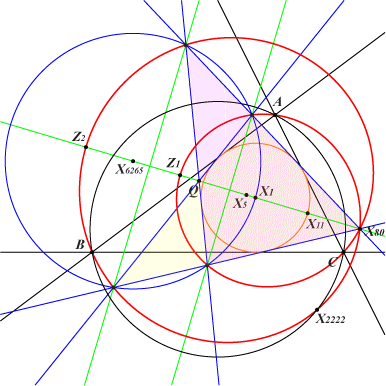
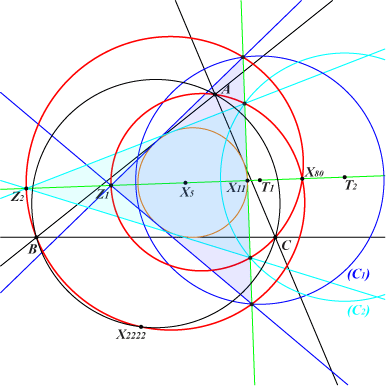
The tangents to the incircle passing through X(80) meet the (blue) circle with center X(6265), radius R, at four points on Q199 which are the vertices of two triangles. The opposite sidelines to X(80) are the tangents to the incircle passing through Q on the line (L). Q is the barycentric product X3218 x X41684. Q = a (a^2-b^2+b c-c^2) (a^4-2 a^3 b+2 a b^3-b^4-2 a^3 c+3 a^2 b c-2 a b^2 c-2 a b c^2+2 b^2 c^2+2 a c^3-c^4) : : , SEARCH = 0.381337312832188. |
Let T1, T2 be the reflections of Z1, Z2 in X(5) and let (C1), (C2) be the circles with centers T1, T2 and same radius R. The tangents to the incircle passing through Z1 and Z2 meet the perpendicular at X(11) to (L) at two pairs of points which lie on Q199 and on the corresponding circles. Two isosceles triangles are obtained with a common sideline opposite to Z1 and Z2. |
||
|
|
|
|
|
|
|
|
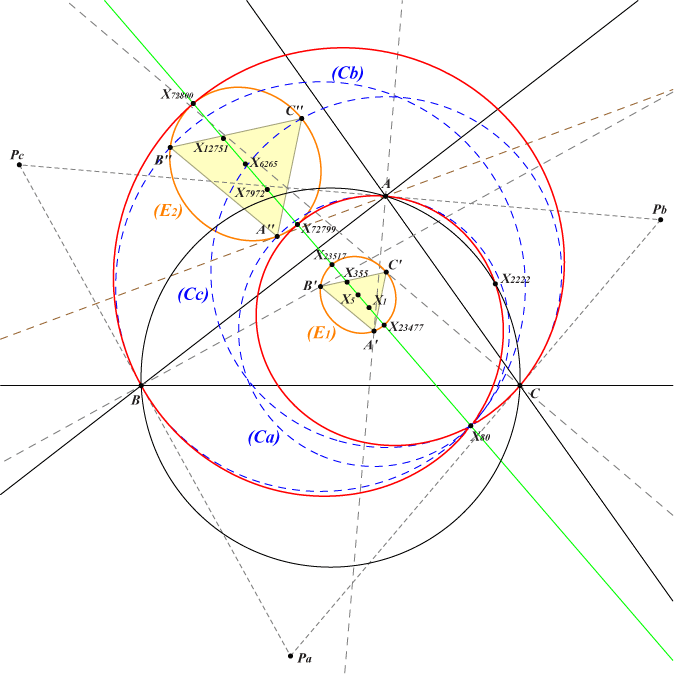
Other characterizations of Q199 Denote by PaPbPc the anticevian triangle of X(37). Let A' be the center of the circle (Ca) passing through X(80) and tangent at A to the line PbPc. Define B' and C' cyclically. Let A" be the homothetic of A' under h(X80, 2). Define B" and C" cyclically. Let (E1) be the ellipse with center X(5), real foci X(1) and X(355) = reflection of X(1) in X(5), vertices X(23477) and X(23517) which passes through A', B', C'. Let (E2) be the ellipse which is the homothetic of (E1) under (X80, 2). Its center is X(6265), its real foci are X(7972) and X(12751), its vertices are X(72799) and X(72800). It passes through A", B", C". Its eccentricity is Sqrt[1 - 2*r/R], its semi-major axis is Sqrt[R*(R - 2*r)] (along the IN line) and its semi-minor axis is Sqrt[2*r*(R - 2*r)]. Q199 is the envelope of circles with center on (E1) which pass through X(80). This is the case of (Ca), (Cb), (Cc). Q199 is also the pedal curve with respect to X(80) of (E2) i.e. the locus of the orthogonal projections of X(80) on the tangents to (E2). |
|
|
|
 |
||
|
|
|
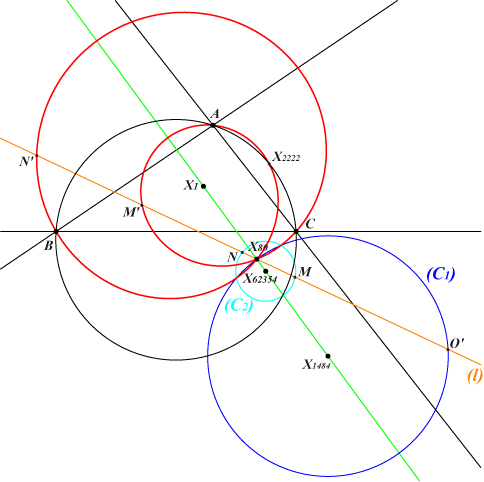
Q199 can also be seen as the cissoid of a pair of circles (C1), (C2) with centers O1, O2 on the line (L) such that (C1) passes through X(80) but not (C2). A variable line (l) passing through X(80) meets (C1) again at O' and meets (C2) at M and N. The reflections M', N' of O' in M, N are two points of Q199. These circles are interdependent, and only a judicious choice will result in Q199. In this case, they intersect at two points on Q199 symmetric in (L). Example 1 (figure below) : (C1) : O1 = (3*R + 2*r)*X[1] - 2*(R + 2*r)*X[5] = X(62354), radius R, through X{80,49176}. (C2) : O2 = 2*R*X[1] - (R + 2*r)*X[5] = X(1484), radius Sqrt[R*(R - 2*r)]/2, through X{5620,10265,13605,21630}. Example 2 : (C1) : O1 = (R + 6*r)*X[1] - 8*r*X[5] = X(9897), radius 2*r, through X(80). (C2) : O2 = 4*r*X[1] + (R - 6*r)*X[5] = X(72874), radius Sqrt[R*(R - 2*r)]/2, through ?.
|
|
|
|
 |
||
|
|
|
|
|