 |
||
Home page | Catalogue | Classes | Tables | Glossary | Notations | Links | Bibliography | Thanks | Downloads | Related Curves |
||
 |
 |
|
too complicated to be written here. Click on the link to download a text file. |
||
 |
||
 |
||
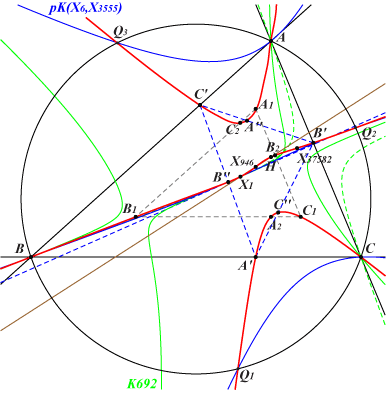
X(1), X(4), X(946), X(37582), X(73296) infinite points of K692 = pK(X6, X8) points on (O) and pK(X6, X3555) which meets K1467 again at three points on the trilinear polar of X(4606) passing through X{1, 210, 2334} other points below note that X(37582) is the tangential of X(1) |
||
Geometric properties : |
||
 |
|
|
K1467 is mentioned by Peter Moses in connection with a problem from the 50th Mathematical Olympiad in Poland, Problems of the first round, September - December 1998. See X(73295) in the ETC. Points on K1467 A', B', C' : vertices of the pedal triangle of X(946) A", B", C" : other points on the sidelines of A'B'C' A1, B1, C1 images of A, B, C under the homothety h(X1, 1/2). This triangle A1B1C1 is perspectif to ABC, A'B'C', A"B"C" at X(1), X(946), P1 respectively. A2, B2, C2 : other points on the sidelines of A1B1C1. This triangle A2B2C2 is perspectif to ABC, A'B'C', A"B"C" at X(4), X(37582), P2 respectively. Note that all these perspectors lie on K1467. P1 = (2 a^5+a^4 b-3 a^3 b^2-3 a^2 b^3+a b^4+2 b^5+a^4 c-a^3 b c+8 a^2 b^2 c-a b^3 c+b^4 c-4 a^3 c^2-3 a^2 b c^2-3 a b^2 c^2-4 b^3 c^2-2 a^2 c^3+a b c^3-2 b^2 c^3+2 a c^4+2 b c^4+c^5) (2 a^5+a^4 b-4 a^3 b^2-2 a^2 b^3+2 a b^4+b^5+a^4 c-a^3 b c-3 a^2 b^2 c+a b^3 c+2 b^4 c-3 a^3 c^2+8 a^2 b c^2-3 a b^2 c^2-2 b^3 c^2-3 a^2 c^3-a b c^3-4 b^2 c^3+a c^4+b c^4+2 c^5) : : , SEARCH = 1.34148055626519, on the lines {946,15325,37582}, {23528, 27385}. The tangential of P1 is X(37582). P2 = a (a^2-b^2-c^2) (2 a^8+a^7 b-2 a^6 b^2-a^5 b^3-a^3 b^5-2 a^2 b^6+a b^7+2 b^8+a^7 c-a^6 b c+5 a^5 b^2 c-5 a^4 b^3 c-5 a^3 b^4 c+5 a^2 b^5 c-a b^6 c+b^7 c-5 a^6 c^2-a^5 b c^2+a^4 b^2 c^2+10 a^3 b^3 c^2+a^2 b^4 c^2-a b^5 c^2-5 b^6 c^2-3 a^5 c^3+a^4 b c^3-6 a^3 b^2 c^3-6 a^2 b^3 c^3+a b^4 c^3-3 b^5 c^3+3 a^4 c^4-a^3 b c^4-a b^3 c^4+3 b^4 c^4+3 a^3 c^5+a^2 b c^5+a b^2 c^5+3 b^3 c^5+a^2 c^6+a b c^6+b^2 c^6-a c^7-b c^7-c^8) (2 a^8+a^7 b-5 a^6 b^2-3 a^5 b^3+3 a^4 b^4+3 a^3 b^5+a^2 b^6-a b^7-b^8+a^7 c-a^6 b c-a^5 b^2 c+a^4 b^3 c-a^3 b^4 c+a^2 b^5 c+a b^6 c-b^7 c-2 a^6 c^2+5 a^5 b c^2+a^4 b^2 c^2-6 a^3 b^3 c^2+a b^5 c^2+b^6 c^2-a^5 c^3-5 a^4 b c^3+10 a^3 b^2 c^3-6 a^2 b^3 c^3-a b^4 c^3+3 b^5 c^3-5 a^3 b c^4+a^2 b^2 c^4+a b^3 c^4+3 b^4 c^4-a^3 c^5+5 a^2 b c^5-a b^2 c^5-3 b^3 c^5-2 a^2 c^6-a b c^6-5 b^2 c^6+a c^7+b c^7+2 c^8) : : , SEARCH = 1.87619920081443, on the line {946, 65702}. P2 is the tangential of X(946). About the infinite points of K1467 These points lie on K692 = pK(X6, X8) and more generally on every pK with • pole Ω on psK(X31, X2, X6) passing through X{6, 9, 19, 478}, • isopivot Q on psK(X31, X2, X1) passing through X{1, 3, 56}, • pivot P on the anticomplement of psK(X31, X2, X1) passing through X{4, 8, 3436}. Apart K692, the most remarkable examples are pK(X9, X3436) and K691 = pK(X19, X4). K1467 and K692 meet at six finite points which lie on the circum-conic with perspector X(4790) passing through X{1, 1014, 1449}. Peter Moses adds the following remarks. If the Feuerbach hyperbola (F) is (a - b)*(a + b - c)*c*x*y - b*(a - c)*(a - b + c)*x*z - a*(a - b - c)*(b - c)*y*z = 0 and the line at infinity (L) is x + y + z = 0, K360 = (a - b - c)*c^2*x^2*y + c^2*(a - b + c)*x*y^2 - b^2*(a - b - c)*x^2*z + 2*(a - b)*(a - c)*(b - c)*x*y*z - a^2*(a - b + c)*y^2*z - b^2*(a + b - c)*x*z^2 + a^2*(a + b - c)*y*z^2 = 0, K691 = c*(a^2 - b^2 - c^2)*x^2*y + c*(a^2 - b^2 + c^2)*x*y^2 - b*(a^2 - b^2 - c^2)*x^2*z - a*(a^2 - b^2 + c^2)*y^2*z - b*(a^2 + b^2 - c^2)*x*z^2 + a*(a^2 + b^2 - c^2)*y*z^2 = 0, Then K1467 = 2*K691 - (F)*(L) = 2*K360 + (F)*(L) = K360 + K691. Note that K360 - K691 = (F)*(L).
|
|